
Outdoor unit placement, airflow and 43 dB(A) planning rules
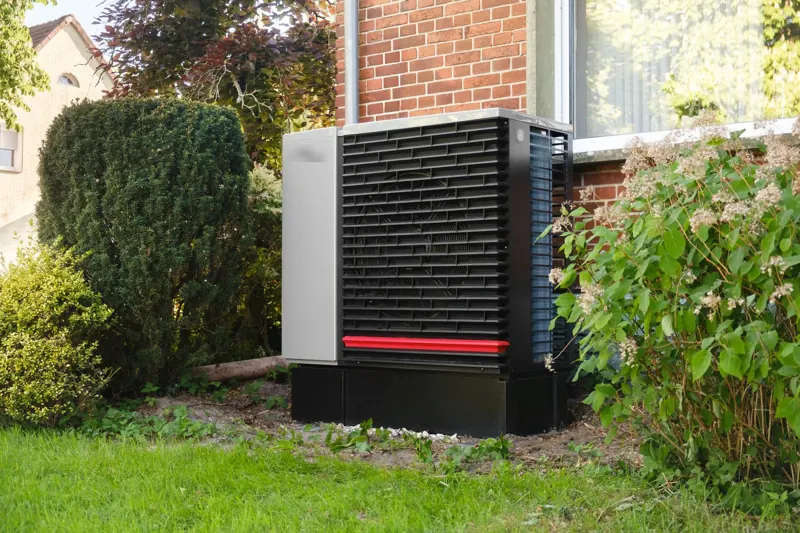
Domestic air-to-water outdoor units on a house are exempt from planning permission under Class 2(d) (S.I. No. 342 of 2026) up to 2.5 m² total area, provided noise does not exceed 43 dB(A) (or 5 dB(A) over background) at the nearest neighbouring dwelling, wall units sit at least 50 cm from edges, and nothing encroaches onto a public road.
Irish Class 2(d) planning exemptions as updated by S.I. No. 342 of 2026, neighbour sound limits, defrost condensate drainage and coastal care.
Free, no obligation. One local installer prices it, not five.
- ≤ 43 dB(A)noise cap at nearest neighbour
- 2.5 m²max total unit footprint
- 50 cmmin gap from wall/roof edge
- €80 / 4 wksSection 5 council check
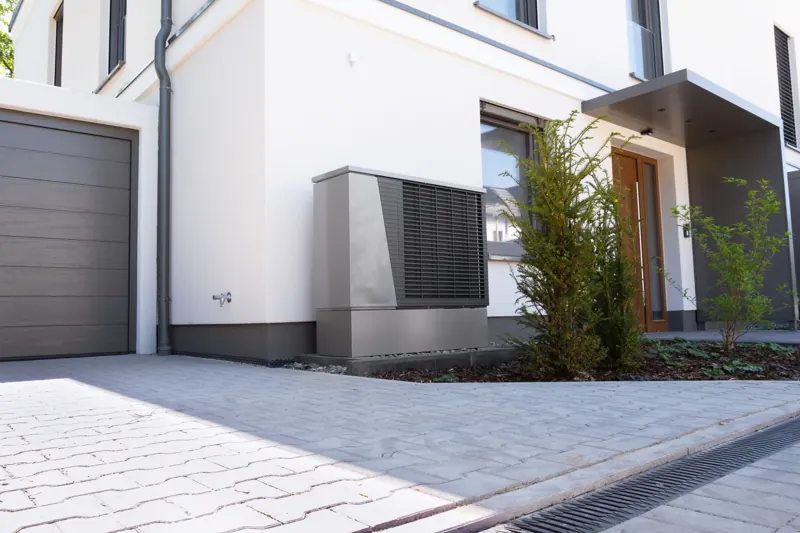
Irish Class 2(d) planning exemption conditions (S.I. No. 342 of 2026)
Domestic heat pumps on a house are governed by Class 2(d) of Schedule 2, Part 1 of the Planning and Development Regulations 2001, updated by S.I. No. 342 of 2026 (in operation from 27 July 2026). That amendment removed the older blanket ban against placing units forward of the front wall of a house, replacing it with a rule against encroaching onto a public road.
- Noise at or under 43 dB(A). Sound during normal operation must not exceed 43 dB(A), or 5 dB(A) above background noise (whichever is greater), measured at the nearest neighbouring inhabited dwelling.
- Total unit area up to 2.5 m². Combined footprint of all heat pump units on the house must stay within 2.5 m².
- Minimum 50 cm from wall or roof edges. Where mounted on an exterior wall bracket, maintain at least 50 cm clearance from every wall corner or roof edge.
- No encroachment onto a public road. Front or side garden placements are permitted on private curtilage provided nothing projects over footpaths or carriageways.
- Groundworks capped at 1 m. Supporting plinths or ground levelling must not alter existing ground levels by more than 1 metre.
Exemptions do not apply to Protected Structures, restrictive Architectural Conservation Areas (ACAs) or apartments/flats. Where doubt exists, a €80 Section 5 declaration from your local council confirms exemption in four weeks.
Price my air-to-water system
Four quick taps and you see the full cost and net after the €6,500 SEAI grant before any phone number is asked for. One local installer rings you, not five.
3-bed semi or terrace (6 to 8 kW), radiators (with K2/K3 swaps), SEAI grant: €12,800 to €18,000 full (€6,300 to €11,500 after €6,500 grant).
How the price is worked out
The range reflects typical Irish supply-and-install air-to-water hydronic heat pump packages at 9% VAT: outdoor monobloc or split unit, indoor controls, a 200 L to 300 L heat-pump hot water cylinder, core pipework, emitter allowance and commissioning. Where SEAI grant applies to a pre-2021 house, we deduct the €6,500 base Heat Pump System grant to give a conservative net figure; qualifying oil or gas boiler swaps can also claim up to €2,000 for central heating upgrades and a €4,000 Renewable Heat Bonus under SEAI rules. Attic or wall insulation upgrades, ESB 16 kVA supply upgrades (€2,245) and floor screed are separate. airtowaterheating.ie is not SEAI or a government body and does not award grants. Only a room-by-room heat-loss survey gives a firm quote.
Airflow, defrost drainage, vibration and coastal siting
- Clear cold-air discharge zone. Keep 1.0 m to 1.5 m clear in front of the fan grille so cold exhaust air never bounces off a boundary wall back into the rear intake coil (which ruins efficiency).
- Defrost condensate soakaway. During cold damp Irish winters, an outdoor evaporator sheds several litres of melted frost water daily. Sit the unit over a pea-gravel soakaway or pipe condensate into a gully so footpaths never ice over.
- Anti-vibration feet over concrete pad. Ground-mounted rubber Big Foot blocks on a level concrete plinth isolate compressor hum far better than bolting brackets directly to a hollow bedroom wall.
- Away from bedroom windows and patios. SEAI DTSS v4.0 recommends keeping outdoor units away from openable living-room and bedroom windows, front doors and garden seating areas.
- Marine anti-corrosion spec near the coast. Within 5 to 10 km of salt water, insist on factory coastal-treated evaporator fins and stainless mounting brackets.
Related air-to-water guides
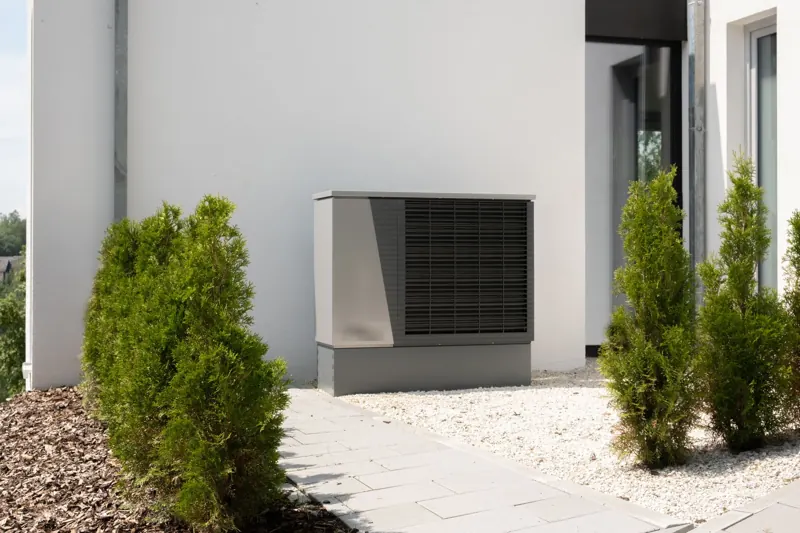 Monobloc vs split heat pumpsR290 sealed monobloc units versus split systems, flow temperature and frost care.
 New-build air-to-water systemsFirst-fix UFH manifolds, airtightness, Part L compliance and 9% supply-and-fit VAT.
 Bungalow and detached retrofits12 to 16 kW sizing, roof and cavity insulation first, and ESB 16 kVA supply checks.
 VAT rates and annual servicing9% supply-and-install VAT, 13.5% standalone work and €180 to €280 yearly servicing.
 ESB supply and weather controls12 kVA vs 16 kVA ESB MIC limits, Safe Electric Cert No. 3 and weather curves.
 Air-to-water costs IrelandFull 2026 Irish price breakdown by house type, emitters, cylinder and SEAI grant.
Common questions before switching
How loud is a modern air-to-water outdoor unit?
Most modern inverter monoblocs produce 40 to 55 dB(A) at 1 metre under normal heating load, roughly the hum of a quiet fridge or gentle rain, dropping well below 43 dB(A) once 3 to 5 metres away.
Can I put a slatted timber screen around the outdoor unit?
Only if it maintains manufacturer-required rear, side and front airflow clearances and leaves full front service access. Tightly boxed enclosures starve the fan and trigger constant defrosting.
Can an outdoor heat pump now go in the front garden in Ireland?
Yes, on a house outside Protected Structures and ACAs. S.I. No. 342 of 2026 removed the old front-wall ban from 27 July 2026, provided the unit stays on private property, meets the 43 dB(A) neighbour limit and does not encroach on a public road.
How far should an R290 propane unit sit from windows and drains?
Follow the exact manufacturer safety diagram; R290 units typically require a 1.0 m exclusion zone from openable windows, doors, air bricks, gullies and ignition sources.
All air-to-water heating pages and guides
Heating setups
Technical guides
See your air-to-water price before anyone rings
Pick your house size, radiators or underfloor heating and SEAI grant route. When you want a room-by-room heat-loss quote, your outline goes to a single local heating installer in your county.